 BluDeskSoft
What Are the 5 Stages of the Product Life Cycle?
Master the 5 product life cycle stages and discover key strategies to maximize profitability in every phase.
Georgiana Nutas
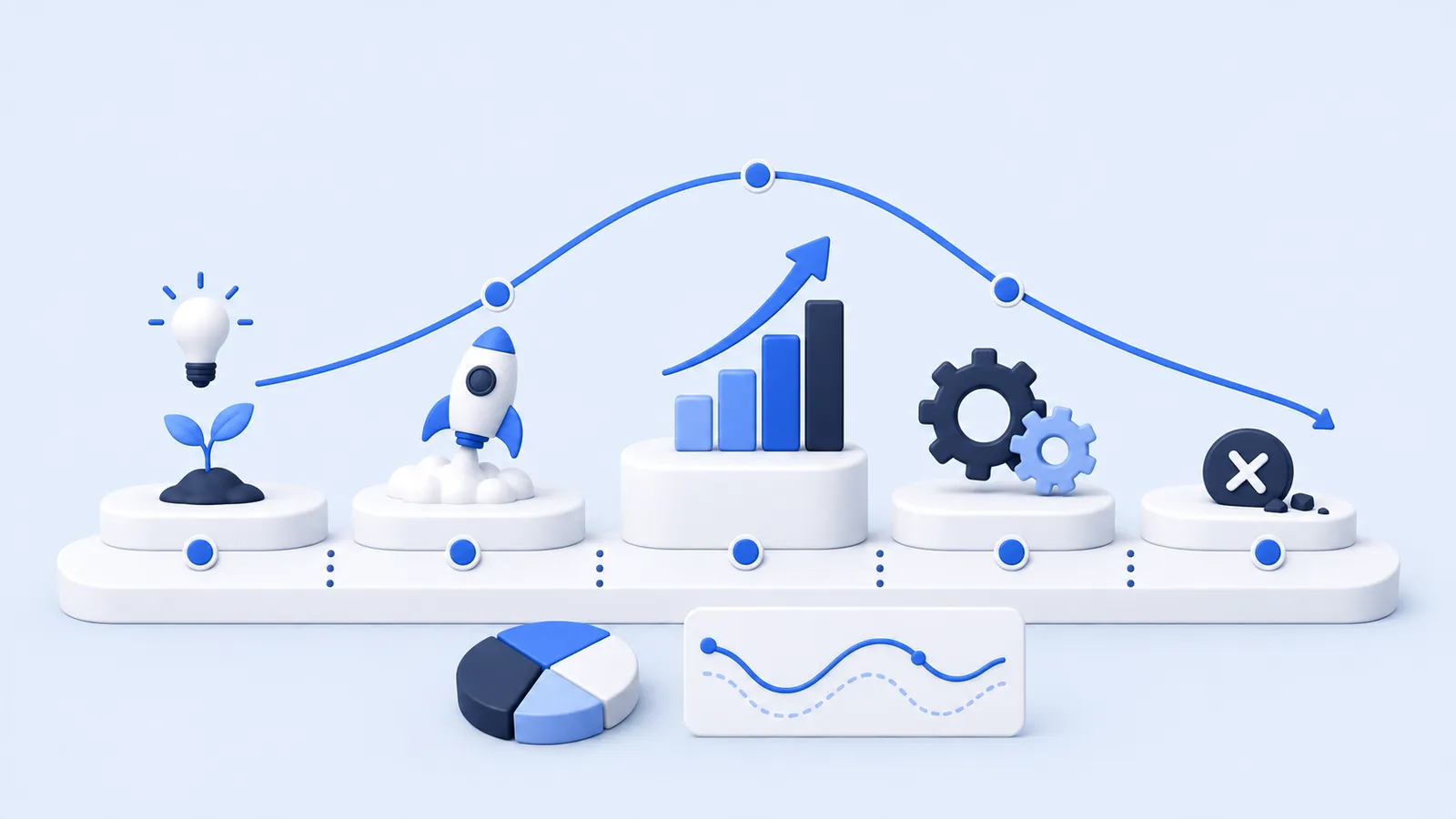
Understanding and mastering your product's journey is the secret to building effective marketing and business strategies. The product life cycle refers to the phases a product goes through, from initial conception and growth to its eventual withdrawal from the market.
Generally, this process is organized into the 5 stages of the product life cycle: development, introduction (launch), growth, maturity, and decline. By precisely understanding how to maximize potential at each stage, companies can improve profitability and extend the product’s lifespan with consumers.
If you have invested resources without seeing the expected results, this strategic look into the product life cycle will provide the perspective needed to ensure your business’s growth.
Hakuna Matata! 🦁
Understanding the Concept
Introduced by economist Theodore Levitt in 1965, the product life cycle remains an essential concept for any business today. Mastering this journey enables a company to implement strategies tailored to each phase and remain profitable.
It is important to note that while the cycle has a clear beginning and end, each stage does not have a fixed duration. The time spent in each phase depends entirely on the product type and the market environment.
The 5 Stages of the Product Life Cycle
1. The Development Phase
This is the "conception" stage, where you design the product. Following market research and framing workshops, you refine the concept and test its viability with your target audience.
- De-risking: Most companies start with a Minimum Viable Product (MVP) or prototype to limit costs and identify uncertainties early. This ensures the product meets user expectations before full-scale development.
- Investment: At this stage, the product generates no revenue; it is strictly an investment phase.
- Modern Approaches: Using NoCode tools and Agile methodologies is ideal for building, testing, and launching faster and at lower cost than traditional coding.
2. The Introduction (Launch) Phase
This is when your product officially launches. The primary goal is to build awareness among your target audience.
Written by
Georgiana Nutas
Building modern web applications at BluDeskSoft. We write about what we learn along the way.
-1-800x450.webp)
-800x450.webp)