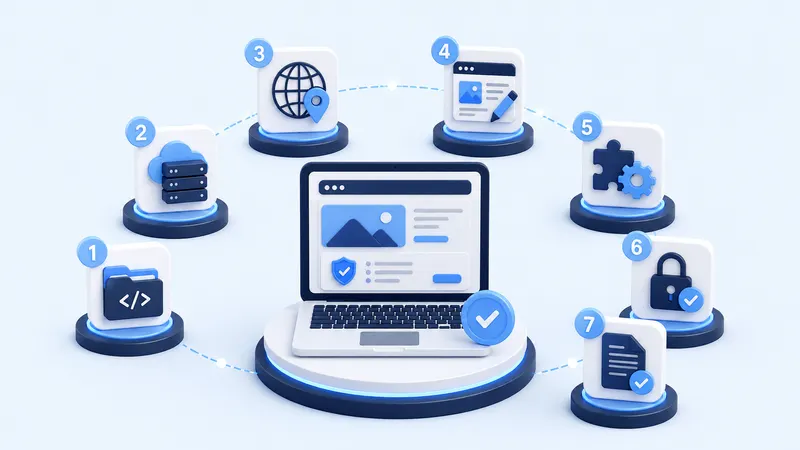
Do businesses still need a website in 2026, when customers can discover brands through Instagram, TikTok, LinkedIn, Google Business Profile, marketplaces, AI search tools, and WhatsApp Business?
It is a fair question.
For many small businesses, social media feels faster. It is easier to publish a post than to maintain a website. It is easier to reply to a message than to optimize a landing page. It is easier to show up where people already spend time than to convince them to visit your site.
But here is the problem: visibility is not the same as ownership.
Social media can help people discover your business. Marketplaces can help you sell. Messaging apps can help you start conversations. But your website is still the one digital space where you control the message, structure, user experience, offer, and next step.
In 2026, a website is no longer just an online brochure. It is your credibility layer, your search engine presence, your conversion hub, your content base, and the one place where your business is not dependent on someone else’s algorithm.
That is why websites still matter.
Why This Question Still Matters in 2026
The way people discover businesses has changed. As the way people use the internet continues to evolve, customers now move between search engines, social platforms, review sites, messaging apps, marketplaces, and AI tools before making a decision.
A potential customer may first see your brand on LinkedIn. Then they might check your Instagram. Then they might search your name on Google. Then they may read reviews, compare alternatives, ask AI tools for recommendations, and finally visit your website before deciding whether to contact you.
That journey is no longer linear.
Customers do not always go directly from search to website to contact form. They move between channels. They compare. They check consistency. They look for signs that your business is real, active, trustworthy, and relevant.
This is where a website still plays a central role.
A strong website gives all those scattered touchpoints a home. It answers the questions your social posts cannot answer properly. It gives structure to your offer. It helps people understand what you do, who you help, why they should trust you, and what they should do next.
Without a website, your business may still be visible. But visibility alone is fragile.
If your only online presence is a social media profile, your business exists inside someone else’s platform. If your only sales channel is a marketplace, your customer relationship is partly controlled by that marketplace. If your only point of contact is WhatsApp, you may start conversations but struggle to build authority at scale.
A website solves a different problem.
It gives your business a stable digital foundation.
Social media is useful. It can help you build awareness, showcase your personality, share updates, start conversations, and stay visible to your audience.
But social media should not be treated as a full replacement for a website.
The reason is simple: you do not fully control social platforms.
Your reach depends on algorithms. Your page structure is limited. Your content can be buried quickly. Your account can be restricted, hacked, suspended, or lose visibility without warning. Even when everything works well, social media is designed around the platform’s experience, not your business goals.
A website gives you more control.
You decide what visitors see first. You decide how to explain your services. You decide how to structure your pages. You decide where to place calls to action. You decide how to collect leads, present case studies, publish content, and guide people toward a decision.
Social media is excellent for attention.
Your website is better for trust, clarity, and conversion.
The strongest businesses usually use both. Social media brings people into the conversation. The website provides them with the depth, evidence, and confidence they need to take the next step.
Why a Website Still Builds More Trust
Trust is one of the biggest reasons businesses still need a website. Studies on local consumer behavior consistently show that customers research businesses online before making a decision, which is why your website, reviews, and overall digital presence need to support each other.
When someone hears about your company, one of the first things they often do is search for you online. If they find only a social profile, the business may still feel real, but it can also feel incomplete.
A professional website signals that your business is established enough to invest in its own presence.
It gives visitors a place to check:
- who you are;
- what you offer;
- who you work with;
- what makes you different;
- how to contact you;
- what results you have delivered;
- whether your brand feels professional;
- whether your business is still active.
This matters especially for service businesses, consultants, agencies, SaaS companies, local businesses, and B2B providers.
A customer may not contact you on their first visit to your site. But your website can still influence the decision. It can reduce doubt. It can answer objections. It can make your business feel safer to approach.
That is why design, copywriting, speed, and structure matter.
A website that looks outdated, confusing, slow, or generic can damage trust. But a clear, modern, useful website can make your business feel more credible before anyone speaks to you.
Your Website Is the One Channel You Actually Control
One of the strongest arguments for having a website is ownership.
You do not own Instagram.
You do not own LinkedIn.
You do not own TikTok.
You do not own Google’s algorithm.
You do not own marketplace rankings.
You do not own social media reach.
You can use those channels, but you do not control them.
Your website is different.
It is the place where you can build long-term assets: service pages, landing pages, blog articles, case studies, documentation, lead magnets, product pages, pricing pages, testimonials, FAQs, and resources.
Those assets can compound over time.
A social post may disappear from attention after a day or two. A strong article or service page can continue bringing traffic, leads, and credibility for months or years if it is well optimized and maintained.
This does not mean every business needs a huge website. But every serious business should have a place online that it controls.
That place should clearly explain the business, support the sales process, and make it easy for people to take action.
A Website Helps Customers Find You on Google
Search still matters.
Even with the growth of social media and AI-powered discovery, people still use search engines when they need information, services, comparisons, local businesses, and solutions to specific problems.
A website gives your business the opportunity to appear when people are actively searching.
That intent is important.
Someone scrolling on social media may be curious. Someone searching for “web development agency for startup MVP” or “WordPress website maintenance service” is closer to a decision. They have a problem. They are looking for options.
A website allows you to create pages around those problems.
For example:
- a homepage for your core positioning;
- service pages for what you offer;
- case studies for proof;
- blog articles for educational search intent;
- landing pages for specific campaigns;
- FAQ sections for common objections.
Google’s own SEO documentation explains that SEO is about helping search engines understand your content and improving your presence in search results. That is much easier to do with a well-structured website than with only a social media profile.
A website also supports local SEO. For small businesses, the combination of a website, Google Business Profile, reviews, location information, and relevant service pages can be very powerful.
Without a website, your search presence is limited.
With a website, you have more opportunities to be found, trusted, and contacted.
A Website Works 24/7 for Leads and Sales
A good website does not sleep.
It can explain your offer while you are offline. It can collect inquiries outside business hours. It can answer common questions before a sales call. It can show your work to prospects who are comparing you with competitors. It can capture leads from search, ads, social media, email campaigns, and referrals.
That is why a website should not be treated as a digital business card.
A business card only gives contact details. A good website guides decisions.
It helps visitors understand:
- what problem you solve;
- whether your offer is relevant to them;
- what makes your approach different;
- what results they can expect;
- what the next step looks like.
For e-commerce businesses, the connection is obvious: the website can sell directly.
For service businesses, the role is slightly different but just as important. The website may not close the entire sale, but it can warm up the lead. It can make the first conversation easier. It can filter out poor-fit inquiries. It can help serious prospects arrive with more context.
That saves time for both sides.
A Website Gives Your Offer a Clear Home
Many businesses struggle not because they lack visibility, but because their offer is unclear.
They post on social media. They talk about their work. They share updates. But when someone wants to understand exactly what they do, the information is scattered.
A website forces clarity.
It makes you answer important questions:
- Who are you helping?
- What do you offer?
- What problem do you solve?
- Why should someone choose you?
- What proof do you have?
- What should visitors do next?
This is especially valuable for startups and growing businesses.
If you are launching a SaaS product, building a service company, creating a marketplace, or selling a specialized solution, your website becomes the clearest expression of your positioning.
It is where messaging, design, product strategy, and conversion flow come together.
A social media profile can create interest.
A website turns that interest into understanding.
And understanding is what moves people closer to action.
Why Design and UX Matter More Than Ever
Having a website is not enough.
A bad website can hurt your business.
If the site loads slowly, people leave. If the navigation is confusing, people get frustrated. If the offer is vague, people hesitate. If the design feels outdated, people question your professionalism. If the call to action is hidden, people do not take the next step.
This is where UI and UX matter.
A website should not only look good. It should help visitors move through a clear journey.
That journey usually looks like this:
- they land on the page;
- they understand what you do;
- they see why it matters;
- they find proof;
- they feel enough trust;
- they know what to do next.
If any step is weak, conversions suffer.
This is why website strategy is not just about visuals. It is about structure, content, speed, mobile experience, accessibility, trust signals, and clear calls to action.
A beautiful website with poor messaging will not convert.
A fast website with a confusing UX will not convert.
A content-heavy website with no clear next step will not convert.
The best websites combine design, performance, copywriting, and user experience into one coherent flow.
When a Simple Website Is Enough
Not every business needs a complex custom platform.
For many small businesses, a simple professional website is enough.
A local service provider may need:
- a homepage;
- a services page;
- an about page;
- testimonials;
- contact details;
- a booking or inquiry form;
- basic SEO;
- mobile-friendly design.
That can already make a big difference.
A restaurant, consultant, freelancer, tradesperson, coach, small agency, or local shop does not always need advanced features at the beginning. They need clarity, credibility, and easy contact.
For many businesses, WordPress can still be a good option. It is flexible, widely supported, and suitable for content-driven websites, small business websites, portfolios, and service pages.
The key is not choosing the most fashionable technology.
The key is choosing the right solution for the business goal.
A simple website that is clear, fast, and well-maintained is better than an overbuilt website that nobody updates or understands.
When You Need a Custom Website or Web Application
Some businesses need more than a simple website.
If your website needs user accounts, dashboards, custom workflows, integrations, payment logic, internal tools, booking systems, data management, or SaaS features, then you may need a custom web application.
This is where the conversation changes.
A marketing website explains the business.
A web application supports how the business operates.
For example, you may need a custom solution if you want to:
- manage client accounts;
- build a SaaS product;
- automate internal processes;
- create a marketplace;
- connect multiple APIs;
- offer user dashboards;
- build a custom booking system;
- manage subscriptions;
- create a private portal;
- replace spreadsheets with a real tool.
In these cases, the website is not just a communication channel. It becomes part of the product or business infrastructure.
That requires stronger technical planning.
You need to think about architecture, security, performance, maintainability, user roles, data flows, and future scalability.
This is where working with an experienced development partner becomes valuable.
At BluDeskSoft, we build custom web applications, WordPress websites, UI/UX design systems, and maintenance workflows for businesses that want to launch quickly without sacrificing quality. The goal is not just to put something online. The goal is to build a digital product that is clear, reliable, and ready to grow.
You can learn more about our work at BluDeskSoft.
The real question is not “website or social media?”
The smart answer is both.
Social media helps you stay visible.
Your website helps you build trust.
Social content creates attention.
Website content creates depth.
Social platforms start conversations.
Your website supports decisions.
Social channels are rented space.
Your website is owned space.
A strong digital presence uses each channel for what it does best.
For example, a business might use LinkedIn to share expertise, Instagram to show behind-the-scenes content, Google Business Profile for local discovery, email for nurturing, and the website as the central destination where all paths lead.
That is a stronger strategy than relying on one channel.
The website becomes the hub. Everything else supports it.
The Bottom Line: Your Website Is Still Your Digital Foundation
So, do businesses still need a website in 2026?
Yes.
But not because every business needs a complicated, expensive, oversized website.
Businesses need a website because they need a digital foundation they control.
A website helps customers find you, trust you, understand your offer, compare your services, and take action. It supports SEO, marketing, sales, branding, credibility, and long-term growth.
Social media is useful. Marketplaces are useful. Messaging apps are useful. AI search is changing discovery. But none of these replaces the need for a clear, owned, professional web presence.
The businesses that win in 2026 will not be the ones that simply “have a website.” They will be the ones who use their website strategically.
A good website should answer real questions.
It should guide visitors.
It should support business goals.
It should load fast.
It should be easy to use.
It should make the next step obvious.
If your website does that, it is not just an online presence.
It is a business asset.
At BluDeskSoft, we help startups, SMBs, and product teams build websites and web applications that launch fast and convert. Whether you need a simple business website, a custom web application, WordPress development, UI/UX design, or ongoing maintenance, we can help you create a web presence that supports real growth.
If your current website feels outdated, unclear, or disconnected from your business goals, it may be time to rethink it.
Your customers are already online.
The question is whether your business gives them a clear reason to trust you when they find you.
 BluDeskSoft
-1-800x450.webp)
-800x450.webp)