MVP vs Full Product: What Should Founders Build First? (2026 Guide)
MVP or full product — which should you build first? The honest answer most agencies won't give you.
G
Georgiana Nutas
·15 min read
The MVP vs full product decision is the first real test of a founder's judgment, and most founders get it wrong in the same direction.
They overbuild.
Not because they're careless. Because they care too much. They want the product to feel serious. They want users to trust it. They want investors to see the vision. So they spend four months building everything before anyone has clicked a single button.
And then they launch. And they wait. And they hear silence.
Here's the honest version of what most agencies won't say upfront: the right answer isn't "build the cheapest thing possible." It's built the smallest reliable version to prove whether this product deserves to grow. The moment you internalize that distinction, the whole decision gets cleaner.
This guide walks through exactly how to make that call, what an MVP actually is, when it's the right move, when it's not, and how to avoid the two failure modes that kill early-stage products.
What an MVP Actually Is (and What It Isn't)
The term gets abused constantly, so let's be precise.
An MVP (minimum viable product) is the smallest version of a product that lets you test a real assumption with real users. Eric Ries defined it in The Lean Startup as the version that collects maximum validated learning with minimum effort. The goal isn't to build less for the sake of building less. The goal is to learn faster.
That distinction matters more than most founders realize.
A good MVP is not:
A broken product
A half-finished product
A proof of concept with no real workflow
An excuse for poor UX or unstable infrastructure
A demo you're embarrassed to show
A good MVP is focused. It solves one clear problem for one defined audience and delivers enough value to test whether the core idea has demand.
Concretely, an MVP could be:
A SaaS dashboard with a single core workflow
A booking platform where only the essential booking flow works
A client portal with login, documents, and messaging
A marketplace limited to one niche and one transaction type
A web app that validates one paid use case before adding advanced features
Tagged:MVPProductDevelopmentSaaS
G
Written by
Georgiana Nutas
Building modern web applications at BluDeskSoft. We write about what we learn along the way.
The test isn't "does it have enough features?" The test is: does this solve a real enough problem for people to use it, pay for it, or ask for more?
What a Full Product Actually Means
A full product is closer to the long-term vision. It includes the features, polish, and infrastructure required to support a broader user experience, not just test it.
Typically, a full product includes multiple user roles, complete onboarding, payment and subscription logic, advanced dashboards, notifications, reporting, admin tools, integrations, automation, permissions, error handling, analytics, documentation, and a scalable architecture with thorough QA.
None of that is bad. All of it is necessary eventually.
The risk is building it before you know what "it" needs to be.
A full product takes longer to design, develop, test, and maintain. Every additional feature is another assumption baked into the code before the market has validated anything. If those assumptions turn out to be wrong, and statistically, 64% of product features built are rarely or never used, you've spent real budget on features nobody wanted.
That's not a hypothetical. That's most products.
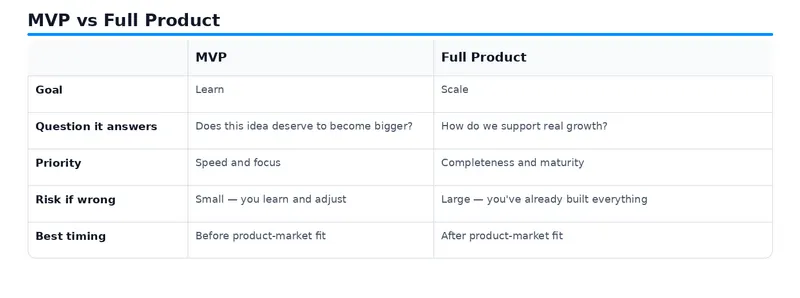
The Real Difference: Purpose, Not Size
The difference between an MVP and a full product isn't scope. Its intent.
Using the wrong one at the wrong time is how products die quietly. Build a full product before validating the core problem, and you end up with something polished that nobody asked for. Build an MVP that's too thin to actually test anything, and you get noise instead of signal.
Why Founders Default to Building More
Most founders don't overbuild out of vanity. They overbuild because they're trying to be responsible.
They want to look credible. They want to compete with established players. They want to avoid the embarrassment of launching something "basic." They want their agency to take them seriously.
That instinct is understandable and expensive.
Early products are built on assumptions. You don't yet know which features users actually value, whether your pricing works, whether your onboarding makes sense to someone who's never seen the product, or whether users will stick around after the first session. Building a full product before answering any of those questions means you're funding guesses with your development budget.
Y Combinator's guidance on building an MVP comes back to the same thing consistently: ship early, talk to users, and treat the market's reaction as the only feedback that counts. Their broader startup advice library echoes it repeatedly: the companies that win don't have the best first version, they have the fastest learning loop.
The market doesn't reward the most complete first version. It rewards the product that clearly solves a painful problem.
The Real Costs of Building Too Much Too Early
You spend the budget before you have proof
Every extra feature costs money, design, development, testing, project management, and ongoing maintenance. If those features are built on unvalidated assumptions, your budget is funding guesses. A focused MVP concentrates spending on the core problem and the minimum experience needed to test demand.
You delay the feedback that actually matters
A full product can take four to eight months longer to launch. During that time, you're not learning from real users, you're building in a bubble. The longer assumptions remain untested, the more expensive they become to reverse.
You lock yourself into the wrong architecture
Early products should be flexible. The more complex the codebase at launch, the harder it is to change direction when you discover what users actually need — and you will discover it's different from what was expected.
You can't identify what's working
Launch with ten features, and users love the product: which feature created that value? Launch with ten features and users leave: which part failed? A focused MVP produces a cleaner signal. You're not trying to analyze the wrong variable.
You ship a polished product nobody needs
This is the most painful outcome. The interface looks good, the code works, the launch happens, and nobody cares. That's not an execution problem; it's a validation problem. A full product can hide a weak core assumption behind excellent execution.
The Real Costs of Building Too Little
The opposite failure exists too, and it's just as common once founders hear the MVP advice and overcorrect.
A bad MVP is too buggy to trust, too limited to demonstrate real value, too confusing for users to navigate, or missing the one feature that makes the whole product make sense. If users reject it, you can't tell whether the idea is wrong or the execution was just too weak to test it fairly.
"Minimum" cannot mean careless. An MVP still needs to be reliable enough for the test you're actually running:
Testing willingness to pay? The payment flow must work.
Testing whether businesses will trust your platform? The experience needs to feel credible.
Testing client retention? Users need enough value to come back.
A good MVP is not the smallest thing you can build. It's the smallest thing that can produce meaningful learning.
When to Build an MVP First
An MVP is usually the right starting point when:
The idea hasn't been validated with real users
You're not certain which features users actually need
You haven't confirmed willingness to pay
You have a limited runway or budget to protect
You want to launch quickly and learn from the market
You're entering a market with uncertain demand
You're building for a niche audience where preferences are unclear
You need investor or stakeholder feedback before committing to thefull scope
An MVP is especially well-suited for SaaS products, marketplaces, internal tools, workflow automation platforms, and productized services.
Example: You're building a CRM for a specific vertical. The full vision includes lead management, email integration, LinkedIn sync, AI lead scoring, pipeline forecasting, invoicing, team permissions, and a mobile app. The MVP might only need contact management, notes, reminders, basic pipeline stages, and admin access.
That smaller version can still be used to test whether the target users care about the core workflow. If they do, you build the next layer with actual evidence. If they don't, you've saved yourself several months of development on assumptions that don't hold.
When a Full Product Makes More Sense
There are situations where a lean MVP isn't appropriate, and being honest about them matters.
A full product is the right starting point when:
You already have paying customers waiting for the product
You're replacing an existing manual process that must work from day one
You've validated demand through real operations (not just interest)
You're rebuilding a product with known user behavior and a clear feature set
You're entering a regulated or high-trust market (fintech, healthcare, legal)
The product needs to integrate with critical business systems at launch
Your brand or reputation depends on quality from the first impression
The question isn't whether a full product is bad. It isn't. The question is whether you have enough evidence to justify building one.
A Better Mental Model: Build in Stages
For most founders, the real answer isn't "MVP or full product." It's staged product development, building in layers, each one justified by what the previous layer taught you.
Stage 1 — Discovery: Clarify the problem before you write a line of code. Who's the user? What pain are they experiencing? How do they solve it today? What would make them switch? What must be true for this product to work?
Stage 2 — Prototype: This doesn't have to be functional software. A clickable design, landing page, or mockup can surface user reactions before you've committed to architecture. Prototypes are cheaper to change than code.
Stage 3 — MVP: The first functional version. Supports the core workflow, allows real users to test the value, and produces measurable learning: Do users complete the main action? Do they return? Do they pay or express willingness to pay? What blocks them?
Stage 4 — First production version: Once the MVP shows traction, strengthen the product. Better UX, stronger security, improved performance, analytics, onboarding, and infrastructure. This is where the product starts becoming something you can sell seriously.
Stage 5 — Growth version: Add features based on evidence, not because they were on the original roadmap, but because users have shown they're needed. Advanced reporting, team features, automation, integrations, and expanded plans.
Stage 6 — Scaled product: Deeper architecture work, performance, monitoring, documentation, and infrastructure to support sustained growth.
Each stage has a different goal. The mistake is skipping to stage five before stage three has taught you anything.
How to Define Your MVP Scope
The hardest part of MVP planning isn't deciding what to build. It's deciding what to cut.
Start with the core user journey. Ask: What is the one thing users must be able to do for this product to create value?
Build around that single journey first. Everything else is secondary.
For a booking platform: User finds available slot → books → receives confirmation → business manages booking.
For a client portal: User logs in → accesses documents → sends request → receives update.
For a SaaS dashboard: User connects data → sees insight → takes action.
For a marketplace: Buyer finds a provider → sends a request → the transaction starts.
Your MVP should support that journey well enough to test it. Features that don't directly support the core journey should wait.
Features to defer in most MVPs
Advanced analytics and complex dashboards
Multiple user roles and permission levels
Mobile app before web validation
AI features without a specific tested use case
Multi-language support before traction
Complex automation and notification systems
Billing plans with multiple tiers
Integrations with every third-party tool
Overly detailed reporting screens
What should never be cut from an MVP
Even lean products need the basics:
Reliable core workflow (the main thing must actually work)
Usable interface (doesn't need to be beautiful, does need to be navigable)
Basic security
Responsive design
Error handling for the core flow
A feedback mechanism so users can tell you what broke
Basic analytics or event tracking so you can see what happened
Lean doesn't mean low quality. Lean means focused.
Budget Decisions and Technical Debt
Budget constraints shouldn't default to "find the cheapest developer." They should default to reducing the scope.
A smaller scope, built properly, is always better than a larger scope, built badly.
Technical debt compounds. If the first version is messy, inconsistent data models, no tests, and copy-pasted logic, every future version becomes harder and more expensive. A rebuild six months after launch costs more than doing it right the first time with a tighter scope.
Instead of trying to build the full vision with a limited budget, strip the scope down to the one workflow that proves the idea. Build that workflow well. Ship it. Learn from it. Fund the next stage with evidence, not hope.
MVP vs Full Product: Decision Checklist
Build an MVP first if:
The idea hasn't been validated with real users
You need market feedback before committing to the full scope
The budget needs to be protected until demand is confirmed
Users can still get value with fewer features
You're testing pricing or willingness to pay
You want to reduce risk before scaling infrastructure
Build a fuller product first if:
Demand is already confirmed
Users are waiting for the product right now
The product replaces a business-critical workflow
The market requires a mature experience to trust you
The product handles payments, sensitive data, or regulated information
Compliance or security requirements are non-negotiable at launch
The most common right answer for early-stage founders is:
Start with an MVP, but build it with production discipline where it matters.
What This Means When Working With a Development Agency
A good agency shouldn't simply take your feature list and start building. That's not product strategy, that's execution without judgment.
The right conversation at the start of any engagement is: what do you actually need to build first, and why? What are you trying to learn or prove? What would make this version successful?
At BluDeskSoft, this is how we approach early-stage web products — starting with the business goal, clarifying the core user journey, trimming unnecessary scope, and building a version that can launch without creating fragile foundations. Whether that means a lean MVP, a clickable prototype first, or a more complete production build depends entirely on what stage you're at.
If you're building a web application and figuring out what to build first, BluDeskSoft works with founders and SMBs to scope and build web products that launch fast and create a clear path forward.
Frequently Asked Questions
What is the difference between an MVP and a full product? An MVP (minimum viable product) is built to learn; it's the smallest functional version of a product that can be used to test whether the core idea has real demand. A full product is built to scale; it's a more complete version designed to support a broader range of users and experiences. The difference is purpose, not just size.
Should I always start with an MVP? For most early-stage founders, yes. Unless you already have confirmed demand, paying users waiting, or a business-critical workflow that must work from day one, a focused MVP reduces risk and lets you invest development budget based on evidence rather than assumptions.
How long does it take to build an MVP? A focused web application MVP typically takes 6 to 12 weeks, depending on complexity, team size, and how clearly the scope is defined. Products that launch in that window almost always do so because scope decisions were made deliberately before development started.
What features should I include in an MVP? Only features that directly support the core user journey. Everything else should wait. Define the one workflow that creates value for your target user, booking, transacting, managing, reporting, and build around that. Anything that doesn't support that flow is a candidate for the next version.
What is staged product development? Staged product development is the approach of building a product in layers, starting with discovery and a prototype, progressing through an MVP, then strengthening the product as you gather real feedback. Each stage is justified by what the previous one taught you, rather than building everything up front based on assumptions.
How do I know if my MVP is too thin? If users can't complete the core action, don't understand what the product does, or can't get enough value to form an opinion, the MVP is too thin. The test isn't "is it minimal enough?" It's "Is it enough to produce meaningful learning?"
The Bottom Line
An MVP vs. full product debate isn't really about size. It's a question about what you know and what you're trying to find out.
Most early-stage founders should start with a focused, well-built MVP. Not a broken prototype. Not a feature-stripped demo. A real, reliable product built around the one workflow that tests the core assumption.
A full product makes sense when demand is already confirmed, the workflow is business-critical, or the market requires a mature experience from day one.
The founders who build the best don't ask "how do we build everything?" They ask: What do we need to build now to learn the most, reduce the most risk, and move the business forward?
That question leads to better products, faster timelines, and far fewer expensive rebuilds.
Compare custom and off-the-shelf CRMs by cost, flexibility, scalability, and business fit.
 BluDeskSoft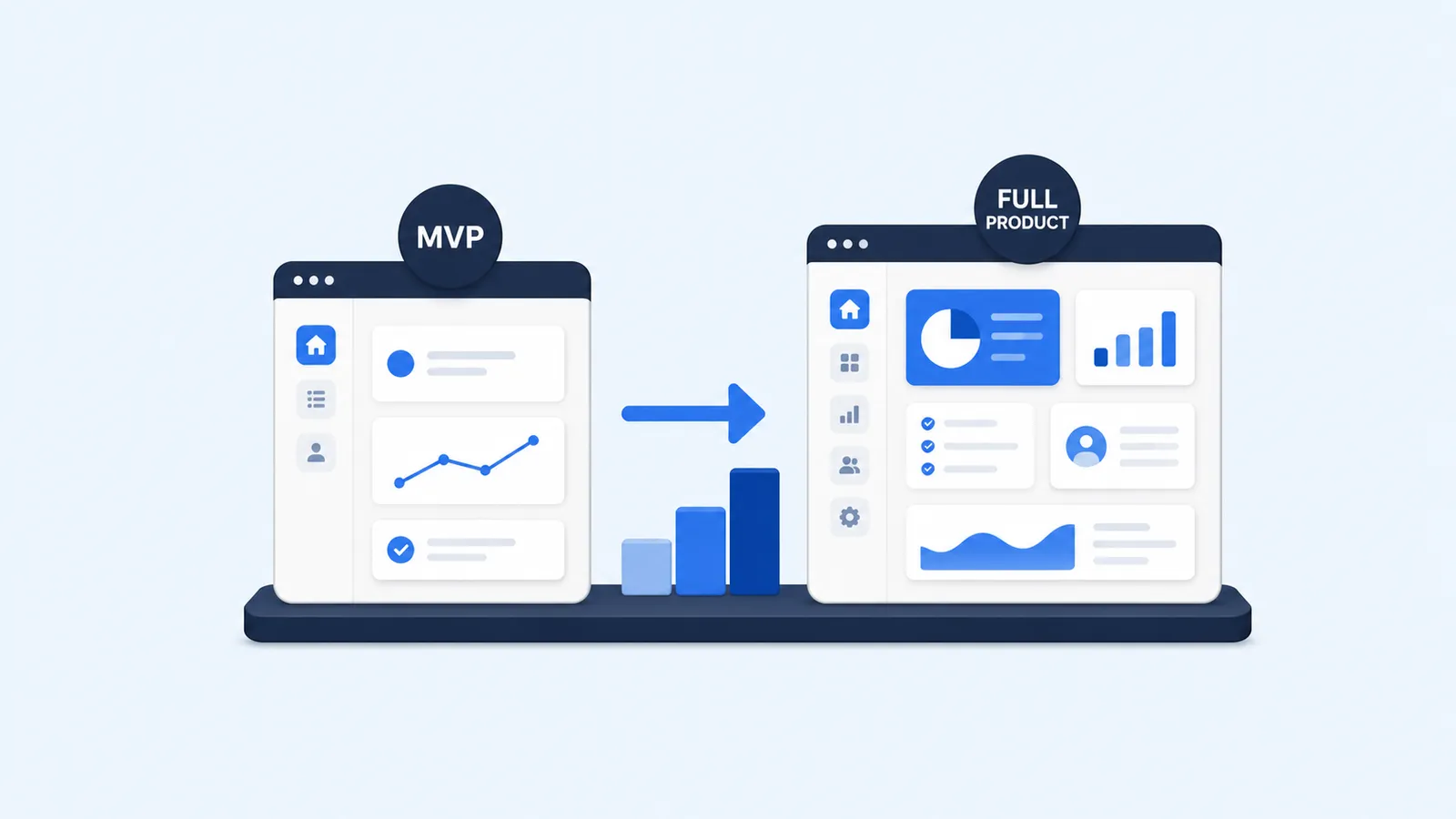
-1-800x450.webp)
-800x450.webp)