WordPress Development Services vs Custom Web Application Development: Which Is Right for You?
WordPress or custom-built? This guide helps you choose the right approach for your project.
G
Georgiana Nutas
·9 min read
Here is the question we hear more than almost any other: should we build on WordPress or go fully custom?
If you have been trying to figure this out, you have probably gotten conflicting answers. Developers tend to push whatever they like building. Agencies lean toward what earns them more. And most comparison articles are too vague to actually help you decide.
This guide is different. We offer both WordPress development services and custom web application development at BluDeskSoft, so we have no reason to push you in either direction. The right choice depends entirely on what you are building, who will manage it, and where your business needs to be in two years. We will help you figure that out.
First, Let's Be Honest: Both Can Work
WordPress powers around 43% of all websites on the internet. That is not a coincidence. It is a genuinely good platform for a wide range of use cases. At the same time, modern custom development using frameworks like Next.js and React has never been more accessible or more powerful.
The question is not which one is objectively better. It is the one that is right for your specific situation. That nuance is what this guide is about.
WordPress Development Services: What You Actually Get
The Strengths
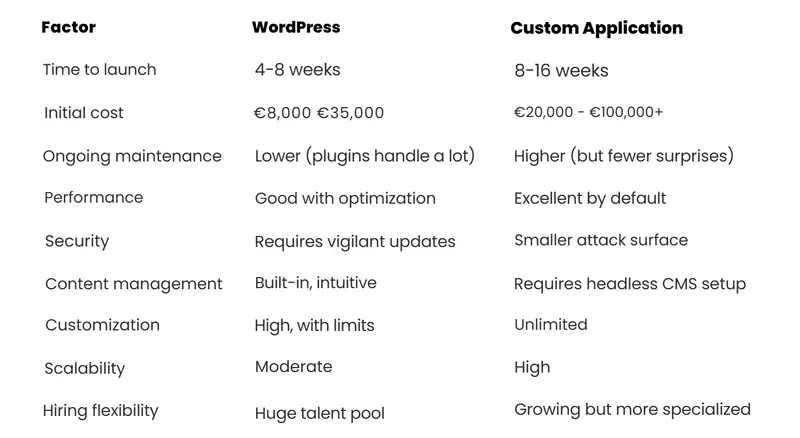
It launches fast. A well-built WordPress site can go from kickoff to live in 4–8 weeks. The ecosystem of themes, plugins, and pre-built components means you are not starting from zero. For businesses that need to move quickly and validate their offer, that speed has real value.
Anyone on your team can manage content. WordPress's editor is familiar to most marketing teams. Publishing a blog post, updating a page, or swapping out a banner image does not require a developer. For teams that want content independence, this matters a lot.
The ecosystem is mature and battle-tested. WooCommerce for e-commerce. Yoast for SEO. Gravity Forms for lead capture. Most standard business needs have plugin solutions that have been running in production for years. You are not betting on an unproven tool.
Lower upfront cost. A professional WordPress site typically costs 30–50% less than a comparable custom build, because development time is shorter and fewer things need to be built from scratch.
Tagged:#webdevelopment #wordpress #custom
G
Written by
Georgiana Nutas
Building modern web applications at BluDeskSoft. We write about what we learn along the way.
Large talent pool. WordPress developers are everywhere. If you ever need to switch agencies, hand the project to an in-house developer, or bring in extra help for a redesign, you will find options quickly.
The Limitations
There is a performance ceiling. A WordPress site with 20+ plugins, a heavy page builder, and unoptimized images can become slow. Every plugin adds HTTP requests, database queries, and potential conflicts. Performance is achievable with WordPress, but it requires deliberate effort to maintain.
Security requires active vigilance. WordPress's popularity makes it a target. Outdated plugins are the most common attack vector for WordPress sites. This does not mean WordPress is unsafe, it means it requires ongoing maintenance. (If you want to understand what that looks like in practice, our website maintenance services guide covers it in detail.)
Customization has limits. WordPress can be extended a long way, but complex business logic, real-time features, or highly interactive experiences often require workarounds that create technical debt over time.
Scaling adds complexity. A WordPress site serving 10,000 monthly visitors and one serving 1,000,000 need very different infrastructure. Scaling is possible, but it is not effortless.
WordPress Is the Right Call When You Are Building:
A marketing website or landing page
A content-heavy site: blog, news, magazine
An e-commerce store with a standard product catalog (WooCommerce)
A professional web presence for a small or medium-sized business
Any site where your team needs to manage content independently without a developer
Custom Web Application Development: What You Actually Get
Custom development means building from the ground up using modern frameworks, typically Next.js, React, and TypeScript. Everything is designed for your specific use case, with no plugin overhead and no inherited constraints.
The Strengths
No performance ceiling. Custom applications are built to be fast by default. No unnecessary code, no plugin bloat, no framework overhead you did not ask for. Sub-second load times are the baseline, not something you have to chase.
We migrated BluDeskSoft's site from WordPress to Next.js + Supabase, reducing load time by approximately 80%. A client we worked with went from an 8-second load time to 1.8 seconds after a custom rebuild, and saw a 35% increase in conversions as a direct result. Performance is not a technical talking point. It is a revenue lever.
Complete control over every detail. Every feature, every interaction, every data flow is designed for your exact use case. No workarounds. No "this plugin almost does what we need." When your business logic is unusual or complex, custom development handles it cleanly.
A much smaller attack surface. A purpose-built codebase has far fewer entry points for attackers than a WordPress installation that relies on a dozen third-party plugins. You are not dependent on plugin vendors to patch vulnerabilities on their own schedule.
Scales without architectural gymnastics. Applications built on modern frameworks and serverless infrastructure scale horizontally without the complex configurations WordPress requires at high traffic levels.
Better developer experience for complex features. TypeScript, component-based architecture, and modern tooling mean faster development cycles once the foundation is in place. Automated testing is standard, not bolted on as an afterthought.
The Limitations
Higher upfront investment. Custom development costs more because everything is built to specification. Budget accordingly.
Longer timeline. Expect 8–16 weeks for a production-ready custom application, versus 4–8 weeks for WordPress.
Content editing needs intentional setup. Unlike WordPress's built-in editor, custom applications need a headless CMS and Sanity capabilities. This is very doable, but it needs to be planned from the start.
Smaller (but growing) talent pool for specific stacks. Finding a Next.js developer is easy. Finding one who matches your exact architecture and quality standards may take more effort than finding a WordPress developer.
Custom Development Is the Right Call When You Are Building:
A SaaS product or web application
A platform with complex business logic: dashboards, portals, marketplaces
A high-traffic site where performance directly affects revenue
Something with real-time features: live updates, collaboration, notifications
A product requiring deep integrations with internal systems or external APIs
Anything you plan to scale significantly over the next 2–3 years
Side-by-Side: The Honest Comparison
7 Questions to Help You Decide
If you are still unsure, work through these questions honestly. They will do more than any comparison table.
1. What exactly are you building? A marketing site or blog? WordPress is the natural fit. A web application with user accounts, dashboards, or multi-step workflows? Go custom. E-commerce? Standard product catalog goes WordPress/WooCommerce. Custom checkout flows, subscriptions, or marketplace features go custom.
2. Who manages content after launch? If your marketing team needs to publish posts and update pages regularly, WordPress's familiar editor is hard to beat. A headless CMS in a custom app can offer similar ease, but it requires upfront intentional setup.
3. What is your actual budget? If your total budget is under €15,000, WordPress will deliver more value. Custom development at that budget forces too many compromises on quality. If you are working with €30,000 or more, both options are viable, and the decision should be driven by requirements rather than cost.
4. How much does page speed matter to your bottom line? For sites where every 100ms of load time affects revenue, e-commerce, lead generation, and SaaS onboarding flows, custom development's performance advantage is measurable and worth the investment. For informational sites where speed matters but is not a direct revenue driver, well-optimized WordPress is sufficient.
5. Do you need real-time features? Live data, collaborative editing, instant notifications, WebSocket connections, if these are core requirements, custom development handles them natively. WordPress was not built for real-time.
6. Where will this be in two years? If you expect traffic to multiply, feature complexity to grow, or integrations to expand significantly, custom development's architecture supports that trajectory more cleanly. If the site will stay roughly the same size and complexity, WordPress's lower maintenance overhead makes more sense.
7. What is your team's technical capacity? A team with no developers benefits from WordPress's self-service capabilities. A team of developers or an agency on retainer can fully leverage the flexibility of a custom build.
The Option Nobody Talks About: Going Hybrid
It does not have to be all-or-nothing. Some of the best setups we have built combine both approaches:
WordPress for content, custom for product. A WordPress blog and marketing site for SEO and content, paired with a custom-built application for the actual product: dashboard, user portal, API.
Start WordPress, migrate later. Launch fast and validate your idea on WordPress. When you outgrow it, migrate the key functionality to a custom application. Your content and SEO stay intact.
WordPress as a headless CMS. Use WordPress purely for content management, powering a custom Next.js frontend. Your marketing team gets the interface they already know. Your users get the performance of a custom build. Best of both worlds.
The Long-Term Cost Picture
The initial build is only part of what you will spend. Here is what the full picture typically looks like over 2–3 years:
WordPress total cost of ownership:
Plugin license renewals: €500 – €2,000/year
Managed WordPress hosting: €300 – €1,200/year
Website maintenance retainer: €200 – €1,000/month
Occasional redesigns as themes age or plugins break
For simple sites, WordPress's total cost of ownership is lower. For complex applications, custom development's predictability and lower incident rate often make it more cost-effective over time. Fewer things break in unexpected ways, and when they do, the surface area is smaller and easier to diagnose.
Three Mistakes That Lead to the Wrong Choice
Choosing WordPress because it feels "safer." Easy to start is not the same as easy to maintain. A WordPress site with 25 plugins, a page builder, and layers of custom PHP can be harder to maintain than a clean, well-structured Next.js application.
Choosing custom because it sounds more professional. Custom development is not inherently better. If you are building a 10-page marketing site with a blog, custom development adds cost and timeline without proportional benefit.
Forgetting about maintenance entirely. Whichever path you choose, someone needs to maintain it. Factor maintenance into your budget from the start, not as an afterthought when something breaks.
The Short Version
Need it live fast and on a tight budget? WordPress. Marketing or content-first site? WordPress. Standard e-commerce? WordPress + WooCommerce. Complex business logic? Custom. Real-time features? Custom. Planning to scale aggressively? Custom. Not sure yet? Start with WordPress. Migrate specific features when you outgrow them.
Both paths can work. The wrong choice isn't WordPress or custom; it's picking either without a clear reason.
Want an Honest Recommendation?
If you are weighing your options and want a straightforward take based on your specific project, talk to our team at BluDeskSoft. We build both, we have migrated between the two, and we will tell you what we would actually do if it were our project.
No pitch. Just a useful conversation.
Apple rejects 1 in 4 apps. Here's why skipping the App Store might be the smarter move.
 BluDeskSoft
-10-1600x900.webp)
-800x450.webp)
-800x450.webp)